Our
Locations

  • World HQ

    6700 Côte de Liesse, suite 206,
    Montréal, Canada,
    H4T 2B5

    +1 514 636-1099
  • Ireland

    Suite 3230, Building 3000, Westpark Business Campus, Shannon, Clare, V14 AN29

    +353 61 475 802
  • San Marino

    World Trade Center, Via Consiglio dei Sessanta,
    99, 47891 Dogana, San Marino

    +39 0549 942-551
Own your journey®

Challenger 350 vs Citation Latitude: A Head-to-Head Comparison

Challenger 350 vs Citation Latitude: Quick Comparison Table

The Challenger 350 and Citation Latitude compete directly in the super midsize category, often appearing on the same shortlists for buyers with overlapping mission profiles and acquisition objectives. At a glance, the single most consequential differentiator is range: the Bombardier Challenger 350 is capable of certain transatlantic missions under favorable conditions, while the Citation Latitude is not. Every other trade-off flows from your mission profile and ownership objectives.

Challenger 350 Specs, Range & Performance

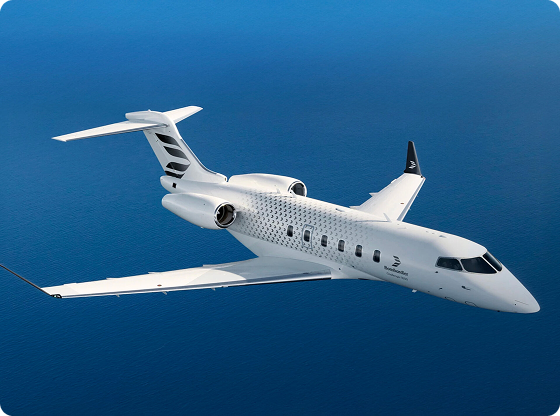
The Bombardier Challenger 350 is powered by two Honeywell HTF7350 engines, each producing 7,323 lbs of thrust — a powerplant that gives the aircraft its class-leading climb and cruise characteristics. Understanding Challenger 350 performance in full context reveals why so many operators choose it as a fleet anchor.

The Challenger 350’s range reaches approximately 3,200 nm with four passengers under NBAA IFR reserves. That figure enables some eastbound transatlantic missions under favorable winds. The Challenger 350 can fly nonstop from New York to London under favorable conditions or from São Paulo to Miami without a fuel stop — missions that require a stop in the Citation Latitude. For operators whose routes touch Europe or South America, the Challenger 350 range is not a specification detail. It is the qualifying criterion.

On cruise performance, the Bombardier Challenger 350 reaches Mach 0.83 / 448 kts and climbs directly to FL430 faster than virtually any competitor in the super midsize segment. That direct climb saves fuel and keeps the aircraft above weather and commercial traffic. A maximum altitude of 45,000 ft and steep approach certification give the Challenger 350 access to demanding airports, including London City and Lugano — airports that many competing aircraft cannot serve.

Additional performance data:
• Takeoff distance: approximately 4,835 ft
• Landing distance: approximately 2,364 ft
• Fuel burn: approximately 239 gal/hr (~905 L/hr)
• Max passengers: 10
• Max altitude: 45,000 ft

For transcontinental domestic US routes — Los Angeles to New York, Dallas to Boston — the Challenger 350 also performs with margin to spare, offering operators scheduling flexibility and a buffer against en-route weather deviations.

Citation Latitude Specs, Range & Performance

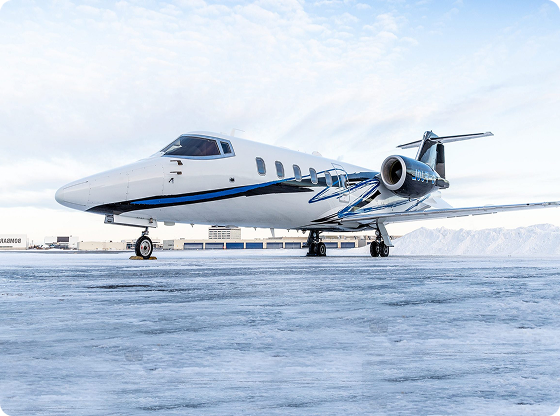
The Cessna Citation Latitude, produced by Textron Aviation, is powered by two Pratt & Whitney Canada PW306D1 engines and represents the widest cabin Cessna had introduced in the Citation family at its launch. Its performance profile is optimized for domestic US and intra-European missions — a profile that accounts for the majority of business aviation hours flown globally.

Citation Latitude range reaches approximately 2,700 nm at four passengers — strong for most continental legs. While that number falls about 500 nm short of the Challenger 350 range, it covers coast-to-coast US nonstop and handles most intra-European routes with ease. Operators whose missions are concentrated within a single continent will rarely bump against the Citation Latitude’s range ceiling.

One performance advantage that is consistently undervalued: the Citation Latitude requires only approximately 3,580 ft for takeoff, compared with the Challenger 350’s 4,835 ft. That ~1,250-foot advantage opens regional airports and shorter strips that the Bombardier Challenger 350 cannot routinely access, giving the Citation Latitude a genuine operational edge in markets where runway length is a limiting factor.

The Citation Latitude’s most underappreciated technical advantage is cabin altitude. At FL450, the Citation Latitude maintains a cabin altitude of approximately 5,990 ft — meaningfully lower than the Challenger 350’s 7,848 ft. A lower cabin altitude means higher cabin air pressure, which translates to better oxygen availability for passengers. On a 3–4-hour mission, that difference is measurable: passengers arrive less fatigued, better hydrated, and with reduced circulatory effects that accumulate at higher cabin altitudes. For operators whose clients are executives traveling to work, not to rest, this is a genuine quality-of-service differentiator.

Additional performance data:
• Takeoff distance: approximately 3,580 ft
• Landing distance: approximately 2,480 ft
• Fuel burn: approximately 246 gal/hr (~931 L/hr)
• Max passengers: 9
• Max cruise: Mach 0.76 / 446 kts
• Max altitude: 45,000 ft

Interior & Cabin Comfort: Side-by-Side

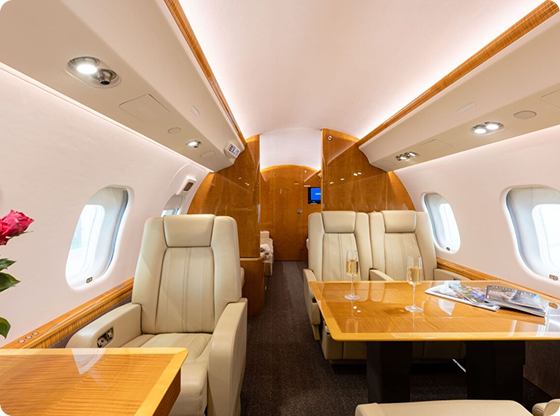
The Challenger 350 interior is defined by volume. The cabin measures 7.68 m long by 2.19 m wide by 1.83 m tall — wider than the Citation Latitude interior by 23 cm, a difference evident throughout the cabin in seat-to-seat spacing, aisle width, and overall sense of openness. Total cabin volume in the Challenger 350 approaches 930 cubic feet, with seating for up to 10 passengers in typical configurations.

The Citation Latitude interior runs 6.63 m long by 1.96 m wide by 1.83 m tall and seats up to 9 passengers. Despite its narrower interior than the Challenger 350, the Citation Latitude’s flat-floor design and efficient layout create a cabin that feels less constrained than the raw numbers suggest. Stand-up height is equivalent across both aircraft.

Key cabin differentiators:
• Baggage: Citation Latitude offers approximately 127 cu ft of baggage capacity vs about 106 cu ft in the Challenger 350, giving the Latitude an advantage for luggage-intensive missions
• Cabin altitude: Latitude’s 5,990 ft vs Challenger 350’s 7,848 ft — a meaningful passenger wellness advantage on longer legs
• Noise: Challenger 350 features sound-suppressing cabin materials; both aircraft rank among the quietest in the super midsize segment
• Both offer fully reclining seats, in-flight connectivity, enclosed lavatories, and galley service

Which Citation Latitude interior or Challenger 350 interior serves passengers better depends entirely on mission length. On a 2-hour domestic leg, the Challenger 350’s additional cabin volume creates a premium feel that justifies its positioning. On a 4-hour transcontinental flight, the Latitude’s pressurization advantage may matter more to passengers than the extra cabin width.

Operating Costs & Annual Expenses

Fuel burn numbers are among the metrics competitors cite most. They are also the least complete picture of what it actually costs to own and operate a Challenger 350 or Citation Latitude. Here is a more complete comparison of operating cost considerations.

Charter and variable costs are shaped by aircraft type, routing, configuration, and the specific maintenance programs covering each airframe — making direct cost comparisons between the Challenger 350 and Citation Latitude highly dependent on individual ownership structure. For charter and operating costs specific to your aircraft, base, and flight profile, contact an ACASS consultant.

On fuel burn, the Bombardier Challenger 350 consumes approximately 239 gal/hr versus the Citation Latitude’s approximately 246 gal/hr. Despite the Latitude’s marginally higher hourly consumption, the Challenger 350’s superior range reduces repositioning requirements on international missions — a factor that can affect overall operational economics on transoceanic routes.

Annual fixed costs (these vary significantly by base location and ownership structure):
• Crew salaries and benefits
• Insurance premiums
• Hangarage and ground handling
• Recurrent training and simulator fees
• Management fees (if the aircraft is placed with an operator)

The Challenger 350 typically carries higher fixed costs than the Citation Latitude, primarily from crew type ratings, insurance classification, and higher acquisition amortization at new-aircraft price points.

One cost variable competitors ignore entirely: the total cost of ownership shifts materially depending on whether the aircraft is operated exclusively for private use or placed on a charter certificate. An aircraft generating charter revenue offsets a meaningful portion of its annual fixed burden — a dynamic that favours the Challenger 350 on longer international legs where positioning rates are highest.

Pre-Owned Market: Availability & Pricing

The vast majority of business jet acquisitions occur on the secondary market — yet virtually every published comparison of the Challenger 350 and Citation Latitude focuses exclusively on new-aircraft acquisition costs. That gap matters for serious buyers.

The Challenger 350 carries a higher new-aircraft acquisition cost than the Citation Latitude. On the pre-owned market, that gap compresses meaningfully — which is why these two aircraft compete so directly in secondary market transactions. A buyer acquiring a 2018-vintage Bombardier Challenger 350 captures transatlantic capability and a wider cabin at a price point that closely mirrors a comparable Citation Latitude, a fact that regularly reshapes shortlists when buyers move from theoretical comparisons to actual market engagement.

The Bombardier Challenger 350 depreciates more steeply than its new price suggests, creating a value opportunity for pre-owned buyers — one that the Citation Latitude’s lower starting cost partially offsets in the secondary market.

Pre-owned value factors to evaluate before transacting on either aircraft:
• Airframe total time and cycle count
• Engine hours and enrollment status (JSSI, MSP, Smart Parts, or equivalent)
• Maintenance status and compliance with current ADs
• Interior condition and avionics upgrade status
• Accident, incident, and AOG history

An independent pre-purchase inspection and third-party aircraft valuation are non-negotiable before committing to either aircraft. Both aircraft are represented by active pre-owned inventories — review current availability in ACASS’s aircraft-for-sale listings.

For pre-owned market pricing specific to your acquisition criteria and timeline, contact an ACASS consultant — our specialists have access to current market data and off-market inventory on both types.

Which Is Better for Charter Revenue?

Most published comparisons of the Challenger 350 and Citation Latitude are written for the charter passenger evaluating which aircraft to book. That framing misses the more financially consequential audience: the owner-operator deciding which aircraft generates better charter yield once placed on an AOC.

For owners placing their Challenger 350 on a charter certificate, the aircraft’s transatlantic range opens up positioning on high-value international legs, where charter rates are substantially higher than on domestic flights. A Bombardier Challenger 350 commanding premium international charter rates on a 6-hour transatlantic leg generates charter revenue that a Citation Latitude cannot match on the same route without a fuel stop — reducing yield and adding operational complexity.

The Citation Latitude makes a strong charter revenue case on domestic circuits. Its lower operating costs per hour and shorter runway access requirements increase the number of airports the aircraft can serve, thereby improving utilization rates on regional and intra-continental routes. An operator running a Citation Latitude on a high-frequency domestic schedule may generate better net returns than a Challenger 350 on the same circuit that does not utilize its transatlantic capability.

Additional charter revenue considerations:
• Regional demand patterns: Challenger 350 has a strong presence in the US fractional market with NetJets; Citation Latitude sees high domestic demand in both the US and European markets
• Repositioning costs: the Challenger 350’s longer range reduces empty-leg repositioning on international missions
• Crew type rating availability: both type ratings are widely held; neither aircraft creates unusual crewing difficulty
• Insurance classification: Challenger 350 typically carries higher hull value premiums, a factor in net charter economics

ACASS Verdict: Choosing the Right Jet for Your Mission

The Challenger 350 is the stronger choice when transatlantic capability is required, cabin width is the priority, charter revenue on long-haul international routes is part of the ownership plan, or the buyer wants the widest stand-up cabin available in the super midsize segment.

The Citation Latitude is the stronger choice when shorter runway access is operationally critical, lower acquisition and annual operating costs are the primary financial driver, domestic or intra-continental missions represent the majority of the flight profile, or passenger wellness on 3–4-hour legs — supported by the Latitude’s superior pressurization — is the deciding factor.

No spec sheet resolves this comparison. The right aircraft is the one that matches your actual route patterns, utilization targets, and financial objectives — not the one with the better headline numbers. ACASS consultants analyze mission profiles against both aircraft’s real-world operational data, drawing on more than $2B in completed transactions and in-house technical expertise that extends to pre-purchase inspections and access to off-market pre-owned inventory.

To receive a personalized comparison of the Challenger 350 and Citation Latitude based on your specific routes and ownership objectives, request a complimentary consultation or aircraft valuation.

Frequently Asked Questions

What is the range difference between the Challenger 350 and Citation Latitude?
The Challenger 350’s range reaches approximately 3,200 nm with four passengers under NBAA IFR reserves. Citation Latitude range reaches approximately 2,700 nm under comparable conditions. That 500 nm gap is the width of the Atlantic — the Challenger 350 can fly New York to London nonstop under standard conditions; the Citation Latitude requires a fuel stop on the same transatlantic crossing, typically in Newfoundland or Iceland. For operators running international missions, Challenger 350 range is not a specification detail — it is the qualifying criterion for the route. For domestic US and intra-European missions, Citation Latitude range is rarely a limiting constraint, and the Latitude performs with a strong margin on most continental legs.

How much does a Challenger 350 cost compared to a Citation Latitude?
The Challenger 350 carries a higher new-aircraft acquisition cost than the Citation Latitude, and that gap compresses meaningfully on the pre-owned market — which is why both aircraft frequently appear on the same secondary market shortlists. A 2018-vintage Challenger 350 and a comparable Citation Latitude trade at closely competitive price points, a dynamic that regularly reshapes buyer shortlists when evaluation moves from new-aircraft to pre-owned options.
Total cost of ownership extends well beyond the initial acquisition figure, encompassing annual fixed costs, variable hourly expenses, and maintenance reserves — factors that materially affect the comparison for any buyer evaluating both aircraft. For pricing specific to your acquisition criteria, contact an ACASS consultant — our specialists have access to current market data and off-market inventory on both types.

Which jet has the more comfortable cabin?
The Challenger 350 interior is wider and longer with greater overall cabin volume — the stronger choice for operators prioritizing space, seating capacity, and configuration flexibility. The Citation Latitude interior delivers superior pressurization at approximately 5,990 ft cabin altitude versus the Challenger 350 interior’s 7,848 ft, and also carries more luggage. On longer legs where passenger fatigue is the deciding variable, the Latitude’s pressurization advantage is tangible and measurable. On shorter domestic flights where volume and flexibility matter most, the Challenger 350 interior leads. Current availability on both types can be reviewed through ACASS’s aircraft listings.

Can the Citation Latitude fly transatlantic?
No. Citation Latitude range of approximately 2,700 nm falls short of a nonstop transatlantic crossing under standard load and reserve conditions. A Citation Latitude flying from New York to London requires a fuel stop, typically in Newfoundland or Iceland — adding complexity and cost to the mission. The Bombardier Challenger 350’s approximately 3,200 nm Challenger 350 range makes it transatlantic-capable under standard conditions. That is the primary performance differentiator between these two aircraft, and the reason the Challenger 350 consistently outperforms the Citation Latitude on international routes. Buyers whose mission profiles include Europe, the Middle East, or South America should treat Challenger 350 range as the deciding criterion, not a secondary specification.

Which super midsize jet is better for short runways?
The Citation Latitude holds a significant short-field advantage on takeoff, requiring approximately 3,580 ft versus the Challenger 350’s approximately 4,835 ft — a 1,200-plus-foot margin that opens regional airports and shorter strips the Challenger 350 cannot routinely serve. Landing distances are nearly equivalent: approximately 2,480 ft for the Citation Latitude and 2,364 ft for the Challenger 350. Both aircraft hold steep approach certifications, enabling access to demanding fields such as London City Airport. For operators who regularly need access to smaller regional airports across European or domestic US markets, the Citation Latitude offers greater operational flexibility — a distinct and compounding advantage on high-frequency domestic schedules.